Scenic Flights / Microlight in Balagne
Discover Scenic Flights / Microlight in the Balagne area!
Microlight in Balagne: Calvi bay, hilltop villages and golden beaches seen from the sky
It is sometimes called the “garden of Corsica”, and one take-off is all it takes to understand why. The Balagne packs into a small area everything the island does best when it comes to photogenic scenery: a bay curved like an arc, a fortified citadel on its headland, stone villages clinging to the hillsides, golden beaches, and, as a backdrop, mountains that keep their snow until spring. From a microlight, the whole scene reads like a living map, with the sea on one side and the ridges on the other.
Our pick of Scenic Flights / Microlight for Balagne
Sorry, no activities were found. Find more activities further down!
Scenic flights and microlight in Corsica
Other activities
Scenic flight and microlight providers in Haute-Corse

The best campsites nearby in Balagne


A region you can take in at a single glance
The Balagne has a rare feature: you can go from the sea to over 2,000 m above sea level without ever leaving the horizon. From an aircraft a few hundred metres above the water, the coastal plain looks tiny, squeezed between the blue of the open sea and the wall of mountains, dominated by Monte Cinto at 2,706 m.
This closeness between sea and mountains creates spectacular contrasts, especially in spring, when the peaks are still white while the beaches are already bathed in sunshine. It is one of the few places on the island where the same photo can capture both snow and sand.
The main landmarks to spot from the sky
Depending on the route, a microlight flight may feature:
- the citadel of Calvi, its ochre stone ramparts and the long beach stretching out at its feet;
- the hilltop village of Lumio, surrounded by terraced gardens and overlooking the bay;
- Corbara and its convent, above the bay of L'Île-Rousse;
- the Pietra peninsula and the colourful houses of L'Île-Rousse;
- the host of high-perched villages, such as Pigna, Montemaggiore and Sant'Antonino, forming a string of small pale dots on the slopes.
The higher you go, the clearer the logic of this landscape becomes: the villages sit perched on the first slopes, above the plain and facing the sea — a location inherited from the centuries when the coast had to be kept under watch.
The beaches seen from above: a palette of blues
This may well be the finest spectacle in the Balagne. From the sky, the sea turns into a colour chart: turquoise over sandy bottoms, milky blue above the seagrass beds, deep blue beyond the drop-offs. Along the coast, the plage de la Pinède, which fringes the bay of Calvi for some 5 km, forms a continuous ribbon of sand lined with trees. A little further east, the beach at Bodri, around 400 m long, offers a small crescent of clear water, while the beach at Lozari, about 1.5 km long, unrolls its golden sand at the foot of the plain.
Morning flights give you more translucent water, with fewer reflections. Late in the day, the low light picks out the contours of the seabed and turns the sea into a coppery mirror.
Mountain terrain within a wing's reach
When conditions allow, some routes head inland. There you can make out the forêt de Bonifatu, its Corsican pines and the bed of the Figarella, which you can explore on foot from the forêt de Bonifatu. In the distance, the ridge line of the Cinto rises like a wall.
This area depends much more on the air conditions: the sun heats the slopes around midday, creating thermals and turbulence. That is why it is worth favouring the morning for flights that venture towards the mountains, when the air is calmer and visibility better.
Wind and weather in the Balagne
The Balagne is generally well exposed, with plenty of fine days, but it experiences two main wind regimes. The libecciu, a west to south-west wind, can whip up the sea and stir the air along the coast. Dry days with light winds, on the other hand, bring exceptional visibility, with peaks standing out sharply on the horizon.
The pilots decide each day whether a flight is feasible and which route to take. Just remember this rule of thumb: the clearer the sky and the lighter the wind, the more comfortable and detailed your flight will be.
When to fly in the Balagne?
May, June, September and early October are the most pleasant periods: the heat is milder, the sea is already warm and the colours are crisp. In July and August, heavy visitor numbers and heat haze can soften the distant views, but morning flights remain superb. In spring, it is the contrast between the sea and the snow-capped peaks that makes flying so special.
Flying with family or friends
A sightseeing microlight takes only one passenger at a time, so families and groups fly one after another. The Balagne has the advantage of offering plenty of activities to keep those waiting entertained. You could, for example, send the children off to an accrobranche course in the Balagne, or leave them on the beach while the more daring take to the skies.
For younger passengers, always check the aircraft's minimum age and weight, and preferably choose a short flight over the bay, which is gentler than a long route.
Where to stay before or after a flight?
To explore around the bay of Calvi, take a look at the campsites in Calvi, close to the beach and the citadel. On the east side, the campsites in L'Île-Rousse make an ideal base for discovering the area.
Other activities to combine with a flight
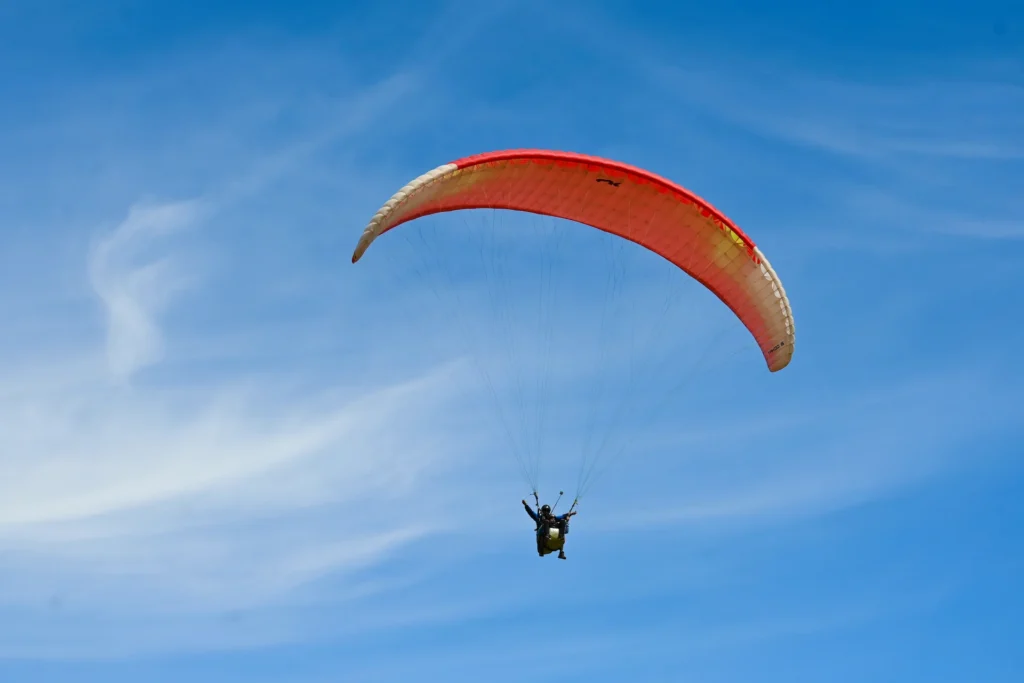
After the sky, why not explore what lies beneath? Diving in Balagne lets you discover the waters you've just flown over, with their drop-offs, gorgonians and wrecks. If you love a thrill, a skydive takes the flight experience further, while paragliding offers a silent, contemplative version of the same height.