Tree climbing on the East Coast
Discover tree climbing in the East Coast region!
Tree climbing on the East Coast
Between the agricultural plain stretching from Moriani to Ghisonaccia and the first wooded foothills of Castagniccia, the East Coast offers a different profile from the rest of Haute-Corse: long straight sandy beaches on one side, hills covered with chestnut trees on the other. The tree climbing courses in the region take advantage of this intermediate wooded strip, often just a few kilometres from the coast, to set up shaded workshops away from the summer bustle of the beaches.
Our selection of tree climbing activities for the East Coast
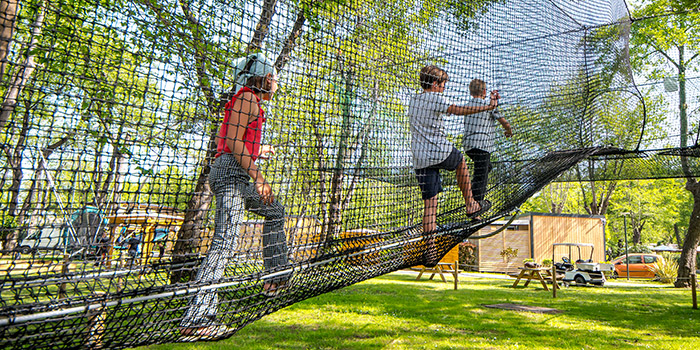
Accrobranche Haute-Corse Merendella Campsite
At the Merendella campsite, in Haute-Corse, the goal is to offer you a holiday where…
Discover the activityTree climbing
Other activities
Treetop adventure courses in Corsica
Mountain forests, between Laricio pines and rivers
Central Corsica owes its identity to its vast Laricio pine forests, an endemic species that can exceed forty metres in height and several centuries in age. Treetop adventure courses installed in this type of woodland benefit from platform heights that are sometimes greater than on the coast, with zip lines that cross entire valleys above rivers or mountain streams. The altitude, often between 400 and 1000 metres depending on the site, also brings a welcome coolness in the height of summer, when the Corsican coast is suffocating in the heat.
The town of Corte, the former capital of independent Corsica and today a university town, is the central landmark of the region: most of the treetop adventure courses in the area are less than a thirty-minute drive from the town.
The karstic and granite terrain of Central Corsica, sculpted by glaciers and then by erosion, offers course designers naturally rugged ground: faults, rocky boulders and marked changes in elevation make it possible to install obstacles at varying heights without having to build imposing artificial platforms. This terrain also explains the presence of numerous natural rock pools and small waterfalls right next to the sites, where it is sometimes possible to cool off between two obstacles.
<0>Between agricultural plain and Castagniccia hills<1>
The Eastern Coast stands out for its plain, the largest in Haute-Corse, long dedicated to viticulture and citrus farming before becoming one of the island's most visited tourist areas. Moving away from the coastline towards the interior, the landscape changes quickly: the plain gives way to the hills of Castagniccia, covered with centuries-old chestnut trees, where treetop adventure courses find dense cover and welcome coolness after a morning at the beach.
This proximity between the coastal plain and wooded hills is one of the region's great assets for organising a varied stay, without having to travel long distances between different activities.
The climate of the Eastern Coast, milder and more stable than that of Cap Corse or Central Corsica, also makes it one of the areas where the treetop adventure season extends most widely throughout the year, with workable conditions from the beginning of spring right through to the first weeks of autumn.
<0>For families, between forest and seafront<1>
The Eastern Coast is one of the areas most frequented by families in Haute-Corse, particularly around Moriani-Plage. The treetop adventure courses in the area take this into account, with circuits graded by age and low-level workshops for the youngest. The terrain, less pronounced than in Central Corsica or Cap Corse, makes it an accessible area even for families unaccustomed to heights.
The immediate proximity of the coastline also makes it easy to organise a morning in the forest followed by an afternoon at the beach, a format particularly appreciated in high season when children need variety in their activities.
Some courses in the region also offer late-afternoon slots, once the heat has subsided, a practical option for families who prefer to reserve the coolest hours of the morning for the beach and treetop adventure for a more temperate moment of the day.
<0>Villages and waterfalls of the hinterland to combine<1>
The hinterland of the Eastern Coast, between the plain and Castagniccia, hides several characterful villages and waterfalls that are well worth a detour alongside a treetop adventure outing:
- The village of <0><1>Cervione<2><3>, a former episcopal seat perched above the eastern plain.
- The village of <0><1>Penta-di-Casinca<2><3>, one of the most beautiful villages in Castagniccia, with a view of the sea.
- The <0><1>Ucelluline waterfall<2><3>, between Santa Maria Poggio and San Nicolao.
- The <0><1>Struccia waterfall<2><3>, nestled in the heights of Castagniccia.
- The <0><1>Bughja waterfall<2><3>, one of the highest on the island with a drop of around one hundred metres.
These sites are mostly located less than twenty-five minutes from the treetop adventure courses set up at the edge of the plain, which allows you to extend the outing with a swim in a river rather than in the sea, for a bit of a change. The roads climbing up towards Castagniccia are winding but regularly offer unobstructed views over the eastern plain and the Tyrrhenian Sea, which makes the journey pleasant in itself, without needing to stop at every bend.
When to go for treetop adventure on the Eastern Coast
The season runs from April to October, with a very pronounced peak in July-August linked to the crowds on the coastal beaches. Spring and early autumn offer pleasant conditions, with moderate temperatures and far fewer people on the plain's roads. In the height of summer, the heat can be quite intense on the eastern plain, which is less breezy than the Cap Corse coastline: favouring morning slots, in the shade of the chestnut trees, remains the best option to fully enjoy the activity without suffering from the heat.
The low season, from October to March, sees visitor numbers drop sharply all along the coast, including around the campsites of Moriani and Ghisonaccia. Some treetop adventure courses take this opportunity to close for a few weeks or reduce their opening hours: a phone call before setting off is always worthwhile outside the April-October period.
A region shaped by agriculture and history
The eastern plain still bears the traces of its agricultural past: old citrus orchards, vineyards, and a network of irrigation canals dating back to the 20th century. The Castagniccia hills overlooking it tell another story, that of a rural Corsica organised around chestnut cultivation, long nicknamed "the bread tree" for its central role in local food. This heritage dimension, less highlighted than the beaches, gives added interest to an excursion into the hinterland after the treetop adventure outing.
The chestnut forests, many of them planted several centuries ago, provide a particularly dense canopy that effectively protects from the sun, even in the height of summer. It is also in this type of woodland, with its gnarled and often impressive trunks, that the hinterland's treetop adventure courses set up their most picturesque stations.
This rural inland Corsica contrasts sharply with the seaside atmosphere of the coastal plain, where campsites, beach restaurants and water sports are concentrated along a fairly narrow coastal strip. Many visitors are surprised to discover just how close the two atmospheres, sea and mountain, are to each other on the Eastern Coast, separated by barely twenty minutes of driving.
Other activities to combine on the Eastern Coast
The diversity of landscapes on the Eastern Coast, between plain, hills and coastline, makes it possible to multiply activities complementary to treetop adventure. Hikers will enjoy the hikes of the Eastern Coast, which lead in particular to the waterfalls of the hinterland. For more thrills, the via ferrata in the area allows you to explore the rocky reliefs of Castagniccia.
As for accommodation, the campsites of Moriani and Bravone and the campsites of Ghisonaccia are excellent starting points for exploring both the coastline and the hinterland. The Camping Merendella network, at Moriani-Plage, also perfectly illustrates the balance between the seaside and the surrounding nature that characterises this entire coast.