Via Ferrata in Central Corsica
Discover the Via Ferrata to try in the Central Corsica region
Via Ferrata Activities Central Corsica: in the heart of the gorges and high mountains
Around Corte, Corsica changes face: the sea disappears behind the ridges and gives way to a dense mountain massif, cut by granite gorges and crowned with peaks that often exceed 2,000 metres. It is in this steep terrain, shaped by the Restonica, Tavignano and Asco rivers, that via ferrata finds a particularly spectacular setting, between vertical walls, natural pools and panoramas over the Corsican high mountains.
Our selection of Via Ferrata for Central Corsica
Unfortunately no activity was found. Find more activities below!
Via Ferrata
Other activities
Two valleys, two mineral atmospheres
Central Corsica is structured around several deep valleys that radiate out from Corte, the island's former capital. Each has its own geological and scenic personality:
- The Restonica Valley, a granite canyon about fifteen kilometres long leading to the glacial lakes of Melo and Capitello
- The Asco Valley, with its 9 km of gorges carved into the granite at the foot of Monte Cinto (2,706 m, the highest peak in Corsica)
- The Tavignano Valley, less frequented, which plunges towards the heart of the massif
- The forests of laricio pines that carpet the slopes between 1,000 and 1,800 metres in altitude
This concentration of gorges and rock faces within a limited area explains why Central Corsica is often considered the most mountainous part of Haute-Corse, with a relief that is markedly steeper than on the coast.
Via ferrata in high mountains: what it changes
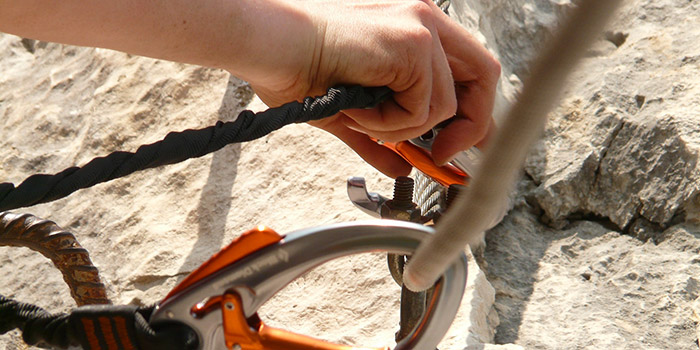
The principle remains the same as elsewhere: continuous protection on a fixed cable thanks to a double-carabiner lanyard, with the help of metal rungs or bars on the steepest sections. But in Central Corsica, the altitude and mountain environment add an extra dimension: the air is cooler, the weather changes faster than by the sea, and the granite walls, often close to 1,000 metres in altitude on the ridges framing the Asco, expose you to a more impressive sense of exposure than on the coastal reliefs.
This more demanding setting also translates into different views: instead of the blue of the sea, it is the surrounding peaks, the laricio pine forests and sometimes residual snow on the highest massifs (visible until spring) that make up the landscape from the most airy sections of a route.
Glacial lakes and mineral walls
The Restonica Valley perfectly illustrates this mineral identity of Central Corsica: the granite canyon it has carved leads to the lakes of Melo and Capitello, two lakes of glacial origin nestled at 1,711 and 1,930 metres in altitude respectively, framed by characteristic rocky towers. The climb is via a well-marked trail from the Grottelle sheepfolds, about 16 km upstream from Corte, and allows you to appreciate up close the texture of the granite polished by glaciers and then by erosion.
Further north, the Asco Valley has a more narrow profile: its 9-kilometre-long gorges enclose the river between granite walls and rocky ridges that exceed 1,000 metres in altitude, directly at the foot of Monte Cinto. This type of relief, both vertical and mineral, is exactly the kind of configuration that via ferrata route designers look for, even if their actual presence always depends on the specific area and changes over time.
Hiking and canyoning: the other faces of the massif
Central Corsica also has the highest density of canyoning routes on the island, driven by snowmelt that feeds the mid-mountain rivers throughout spring and part of summer. Canyoning activities in Central Corsica thus explore the same granite gorges, but descending and in the water rather than progressing through the air. For a more peaceful approach to the same relief, the hiking trails in Central Corsica, including some sections of the legendary GR20, allow you to reach on foot most of the viewpoints otherwise accessible by via ferrata.
Beginners and altitude: a few precautions
The via ferrata remains accessible to beginners in Central Corsica, provided you take into account the specific features of the inland mountains. Children can generally start from the age of 8-10 on short, supervised sections, but the altitude and relative coolness of some sites mean you should bring a warm layer even in summer. Afternoon thunderstorms, frequent in the Corsican mountains in high season, also justify favouring morning outings and keeping an eye on how the sky is developing rather than setting off on an exposed route if in doubt.
A helmet, harness and energy-absorbing lanyard remain the core of the equipment, generally available for hire from the organisations that supervise the activity. Sturdy hiking boots are particularly recommended here, as the approach terrain to the foot of the walls is often more uneven than by the sea.
It is also worth finding out about remaining snow before an early-season outing: some access routes to the highest gorges can stay damp or slippery late into spring, even when the coastal plain is already enjoying summer temperatures.
When to do the via ferrata in Central Corsica
The useful season is a little shorter than elsewhere in Haute-Corse because of the altitude: it generally runs from June to September, once the snow has melted on the access routes to the highest gorges. Early summer still benefits from a strong flow of water in the neighbouring torrents, while September offers lower visitor numbers and soft light on the ridges. Outside this period, snow and cold make most high-altitude routes impassable or dangerous, unlike the coastal areas where the activity remains possible almost all year round.
Extending your stay around Corte
Corte, the former capital of independent Corsica, serves as a natural base for exploring the whole massif. Perched on its rocky outcrop, the town overlooks the confluence of the Tavignano and the Restonica, already offering a first glimpse of the verticality that characterises the whole region. The campsites in the Corte area make it easy to branch out towards the Restonica, the Asco or the Tavignano depending on the day's plans. For waterfall lovers, the region is also home to some of the most beautiful waterfalls in Haute-Corse, which you can find on the page the most beautiful waterfalls in Haute-Corse. For an overview of the activities available by area, the page activities in Haute-Corse remains a good starting point.