Canyoning Bastia / Cap Corse
Discover the canyoning activities available in the Bastia / Cap Corse region!
Canyoning in Bastia and Cap Corse
Between the Bastia urban area and the Cap Corse peninsula, the mountains are never far from the sea. Barely out of town, the terrain rises abruptly: schist ridges, deep ravines and torrents that tumble down to the coast in just a few kilometres. It is this closeness between sea and peaks that gives the area its distinctive character for canyoning, a practice that is more discreet here than in the centre of the island, but very much a reality for those who know where to look.
Our selection of canyoning activities for Bastia / Cap Corse
Unfortunately no activities were found. Find more activities below!
Canyoning
Other activities
Canyoning in Corsica
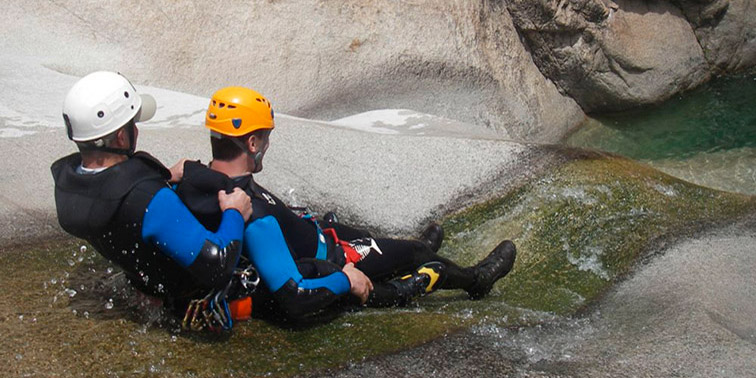
A landscape squeezed between sea and peaks
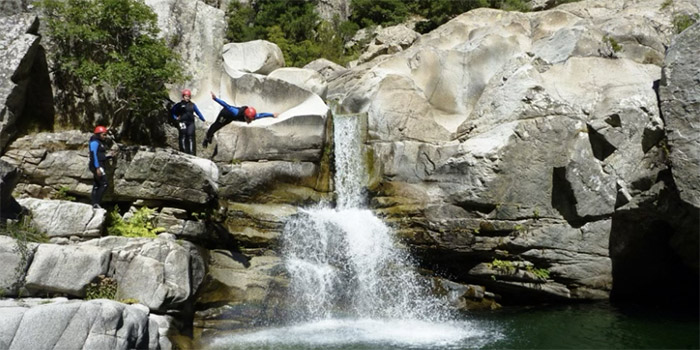
Cap Corse forms a narrow mountain ridge, resting on the sea for nearly 40 kilometres, culminating in Monte Stello at 1,307 metres. Behind Bastia, the massif extends towards Serra di Pigno, whose foothills overlook the town and the Old Port. On this lustrous schist terrain, water never lingers: the torrents born in the heights carve short, steep gorges before reaching the Tyrrhenian Sea on one side or the Gulf of Saint-Florent on the other. This is coastal mid-mountain canyoning, very different from that practised around Corte or the Niolu, with shorter routes but often wilder ones, still little waymarked and rarely visited.
Villages, towers and coves: the landmarks of the area
- 1. Old Bastia and the hinterland towards the Serra di Pigno
- 2. Erbalunga, a fishing village with Genoese towers, a few kilometres north of Bastia
- 3. Nonza and its black schist coast, on the western slope of the cape
- 4. Monte Stello, the highest point of Cap Corse, visible from much of the coastline
- 5. Macinaggio and Barcaggio, at the extreme northern tip of the peninsula
6. This comb-like geography, with valleys perpendicular to the coast, explains why each slope of Cap Corse has its own small torrent, without any of them having become a large-scale canyoning tourist site like some canyons in central Corsica.
7. A little-known practice, between spring torrents and schist gorges
8. Canyoning in Cap Corse remains a niche activity. Specialist guides in the area list only a very limited number of identified routes on the peninsula, compared with several dozen in the centre of the island. This scarcity stems from the terrain itself: short catchment areas, water that quickly runs low after the snowmelt, and the absence of large high-altitude reservoirs to sustain a stable flow in summer. The torrents that tumble down from the heights of Bastia and Cap Corse mainly offer beautiful pools and a few rocky drops in spring, when the snowmelt from San Petrone and the neighbouring peaks still feeds the waterways. After June, many of these gorges partially dry up, which explains why the practice there is more low-key than in the great canyons that are fed all year round. To gauge the region's hydrological potential outside of canyoning proper, the page devoted to the most beautiful waterfalls in Haute-Corse gives a good overview of what the Corsican terrain can offer in terms of waterfalls and natural pools.
9. The customs officers' path, a natural complement to canyon descents
10. Cap Corse is above all a land of coastal paths, and the most emblematic of them, the customs officers' path, links Macinaggio to Centuri over about 19 kilometres, hugging the coves and old watchtowers at the tip of the peninsula. For anyone canyoning in the area, this path is an excellent complement: a morning in a gorge up in the hills, followed by a stretch of coastline in the afternoon, lets you discover both faces of Cap Corse in a single day. The route alternates between wind-battered low maquis, isolated coves accessible only on foot and fishing villages clinging to the rock, in striking contrast to the mineral, enclosed atmosphere of the inland torrents. The page dedicated to hikes in Bastia and Cap Corse gives more detail on the area's other itineraries, from Monte Stello to the ridges of the Serra di Pigno.
11. Family and beginner canyoning
12. The torrents of Cap Corse and the Bastia hinterland are best suited to people already comfortable in white water and on unstable rocky terrain, rather than to a very first taste of canyoning. The terrain there is more confined and less developed than in the great canyons of central Corsica, with sometimes long approaches and few deep pools suitable for a long swim. For a family or beginners who would first like to get to grips with the activity in a more supervised setting, it is better to turn to the more accessible routes of Balagne or Central Corsica, and then come back to explore the wilder gorges of Cap Corse once more experienced. That does not stop you from enjoying the area in other ways: many campsites in Cap Corse offer a comfortable base for exploring between gentle hiking, swimming and village strolls, while waiting for a more technical canyon descent.
13. When to go: the ideal window between May and October
14. The best time to consider a canyon in the area is between late spring and early autumn, when water and air temperatures allow for comfortable conditions. The months of May and June still benefit from the snowmelt of the neighbouring peaks, with more generous flows in the torrents of Cap Corse; summer, from July to September, offers warmer water but sometimes more modest waterways, so it is important to check the conditions on the ground before setting off. Outside this window, the damp, the cold and the irregular flow make the practice noticeably less comfortable, or even risky on already demanding terrain. The area remains easily accessible from the campsites of Bastia, just a few minutes from the first hills, making it easy to organise a trip without travelling far.
15. Other activities to combine around Bastia and Cap Corse
Canyoning is just one of the ways to explore the terrain and coastline of the area. The Cape Corse coast is very well suited to scuba diving, with rocky seabeds that extend underwater the same mineral landscape found in the gorges. Sea kayaking, meanwhile, lets you follow the coves and Genoese towers from the water, a perspective very different from that of the customs officers' path. To round off a busy day, Barcaggio beach, at the very northern tip of the peninsula, offers a wild and unspoilt setting, ideal for relaxing after the effort. Those who wish to extend their stay beyond a single day will find plenty to fill several days on site, between mornings in the gorge, afternoons on the water and evenings in the coastal villages.